
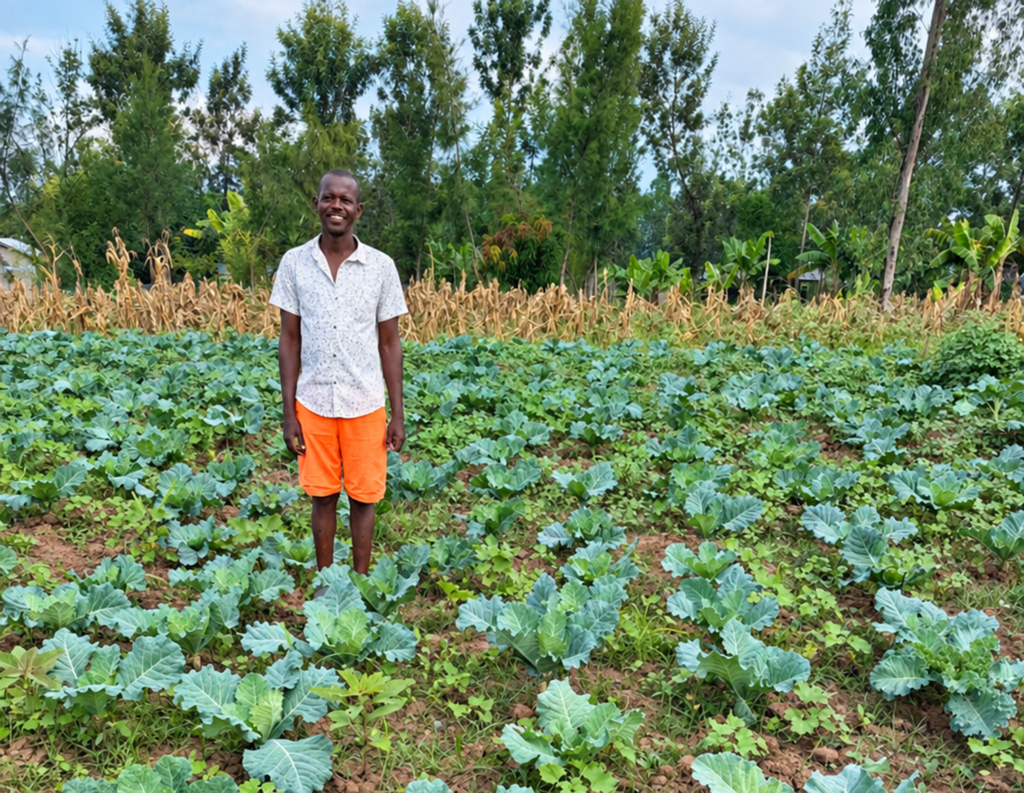
Five plots, one rented pump, $116 a week: Victor‘s irrigated farm
For 19 years, Victor Omondi grew maize on his family’s ancestral land in Kisumu County, Kenya, a staple crop that gets by on rain and patience. Nearly everyone around him still grows it. He supplemented that income with construction work until the COVID-19 pandemic ended it, leaving him to find another way to support his family. Two years ago, he switched to kale, spinach, and cowpeas instead, though keeping them watered wasn’t simple.
He’d tried irrigation once before, running a small petrol-powered pump he couldn’t afford to keep fueled. When the fuel costs caught up with him, he switched to watering by bucket instead and found a different kind of limit: there were only so many buckets one person could carry in a day, and his plots grew only as large as his arms allowed. A variety of irrigated crops can bring in more than maize, but only for a farmer who can water them through the dry stretches that maize can simply outlast. Buckets weren’t enough, and for a while, that first attempt looked like a dead end.
A rented MoneyMaker Max changes the irrigation math
The change came through a neighbor. Victor got his seedlings from Linda Achieng, a local greenhouse operator who has built her own farm into one of the larger operations in the area, and who has since branched out into renting pumps of her own to other farmers nearby. Something about her setup caught his attention: a MoneyMaker Max pump doing in an afternoon what his buckets couldn’t manage in a week. He decided to try irrigation again, renting a MoneyMaker Max two days a week for 300 to 500 Kenyan shillings (about $2 to $4) a day, paid a month in advance. Two hired hands help him run it, and he’s saving toward a pump of his own. Renting first let him prove the pump would pay for itself before he committed to buying one.
That rented pump now waters five plots of spinach (which, in Kenya, refers to a variety closer to Swiss chard than the spinach known in the U.S.), along with cowpeas and kale. Victor rotates cowpeas in after each kale harvest and plants onions alongside both, whose scent helps keep pests away without store-bought pesticides, a rhythm he’s worked out over two years of trial and adjustment. Each plot brings in about 3,000 Kenyan shillings (about $23) a week on its own. Put five plots together, and Victor earns roughly 15,000 shillings (about $116) a week, three to four times what construction work ever paid him. Once a month, he hires around 15 people for two days of weeding. He fertilizes his rows with cow and chicken manure for now, though he’s planning to start his own chicken flock soon so he can produce that fertilizer directly.
New income, a rare market, and family life
Crops like these are still rare enough in Victor’s community that only two or three other nearby farmers grow them at all, he reports. That’s not surprising: less than 4% of Africa is irrigated, and maize needs little water to survive. That scarcity works in Victor’s favor: he isn’t competing for buyers; he’s waiting for them. Women from a nearby market walk straight to his farm to buy, then resell the produce themselves—no middleman between them and Victor. For them, that means fresher produce and a shorter trip.
The new, steady income has reshaped more than the farm. Victor built a new house next to his fields, the kind of investment that would have been hard to imagine on a construction wage. During school holidays, his six children come out to help. Ask him who deserves the credit for how well the farm runs, though, and he points elsewhere.
“She’s the brain behind the farm,” he says of his wife, an agronomist by training.
Next up: Read how Linda Achieng, the same greenhouse operator who inspired Omondi, grew her seedling business into a five-acre operation.