Steady growth in South Sudan: how Moses built year-round income with affordable irrigation
In South Sudan, where conflict, displacement, and extreme weather make farming difficult, Moses Modi Paul’s experience shows how reliable irrigation can bring greater consistency to smallholder farming, even in the most fragile of contexts. A vegetable farmer and father of eight in Kajo Keji county, Central Equatorial State, Moses supports his family through agriculture, working with limited resources in one of the world’s most challenging places to build a stable livelihood. For farmers here, the obstacles are not just environmental. Roads are rough, markets are scarce, and the weight of years of conflict is felt across farming communities throughout the region.
Smallholder farming without reliable irrigation: long hours, limited harvests
Before he started using a MoneyMaker pump, Moses depended on rain-fed farming and watering cans, which are heavy and slow, limiting how much he could grow and when. Hours of labor each day went into simply moving water, leaving little time or energy to expand his plots or diversify what he planted. His harvests brought in around $300 a season, often not enough to cover school fees, food, and medical expenses for a large household. He tried a generator-powered pump to extend his growing season, but fuel and maintenance costs quickly made it unsustainable. During dry spells, production slowed or stopped. He was putting in long days and still coming up short.
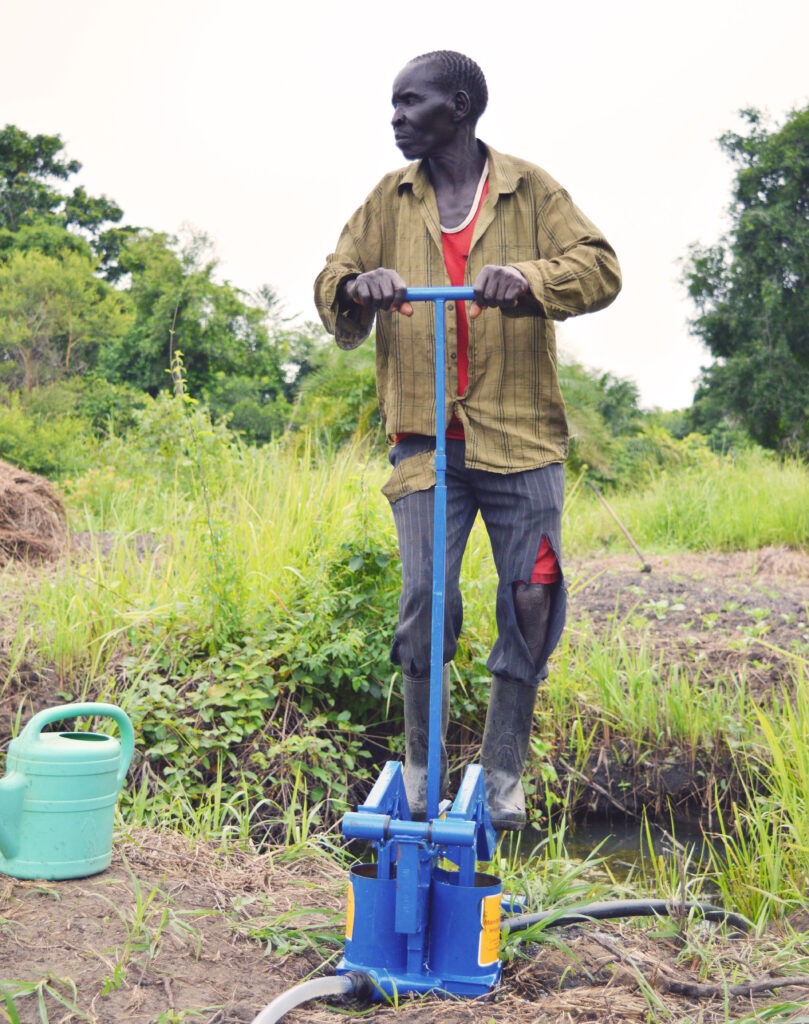
The turning point came when KickStart staff arrived in Kajo Keji to run an irrigation demonstration for a local partner. Moses had previously come across the MoneyMaker Max online but had no way to purchase one locally. Seeing it in person made the decision straightforward. The fuel-free design addressed exactly what had made the generator pump unworkable, and the efficiency gains were significant: tasks that had once taken up to eight hours a day could now be done in about two, freeing time and energy to expand his plots and plant more frequently.
Doubled production, more consistent income
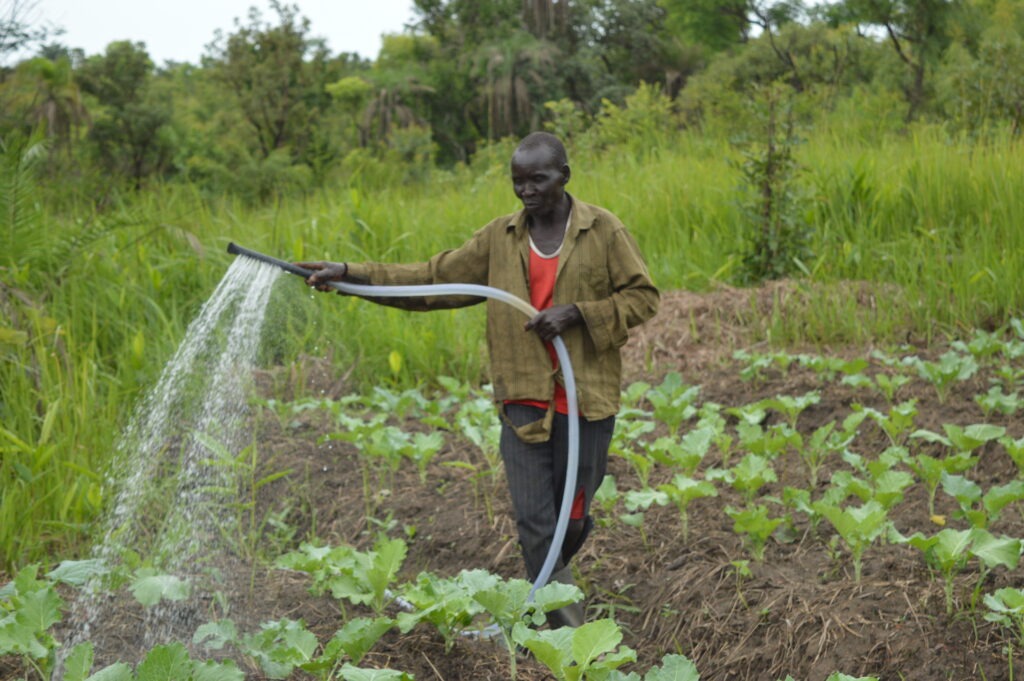
Moses purchased the pump through an installment plan from Tuldux General Trading, a local agro-dealer, and received hands-on training from KickStart staff on how to operate and maintain it. With reliable irrigation, he began farming year-round and doubled his production. His earnings per harvest rose to between $600 and $700, with vegetables now sold across three local markets (Wudu, Mere, and Leikor), as well as small restaurants, market vendors, and a nearby hospital. Buyers who once had to wait for the rainy season now depend on his produce throughout the year. Showing up reliably when other smallholder farmers cannot has helped Moses build lasting relationships with buyers and a more predictable income stream.
The change at home has been just as tangible. More consistent harvests have reduced the month-to-month pressure of meeting basic household needs and given the family space to plan ahead. Moses has spoken about how the family sat down together to set their next goal: saving toward a motorized tricycle to get produce to market faster. It is the kind of forward planning that becomes possible when income is no longer tied to the rains.
Sharing smallholder knowledge, strengthening the community
Moses was among the first smallholders in his area to adopt the MoneyMaker Max, and he has not kept that experience to himself. He actively shares what he has learned with neighbors and encourages other farmers to consider irrigation as a practical, proven approach to strengthening their farms and earnings across the seasons. In a region where a single dry spell can undo months of work, that kind of knowledge sharing carries real weight, and reflects how access to one practical tool can ripple outward through a community.
Today, farming is Moses’ primary source of income, not a supplemental activity managed around other constraints, but a viable, year-round livelihood built on reliable water access and his own accumulated knowledge. His story reflects what many smallholder farmers across sub-Saharan Africa are already doing: identifying the gaps that limit their productivity, finding proven tools to address them directly, and steadily expanding what is possible.