The data is in: irrigation ranks among the most effective tools for smallholder farmers to protect from extreme weather, with up to 10x returns.
For smallholder farmers across sub-Saharan Africa, unpredictable weather isn’t an abstract concern. It’s a bad harvest. A dry season with nothing to sell. A flood that washes away seedlings days after planting. For families farming small plots of land with no financial cushion, these shocks don’t just hurt. They can set a household back by years.
New research from the McKinsey Global Institute confirms what KickStart has seen on the ground for over two decades: irrigation is one of the most effective and proven tools for protecting farming families from drought and extreme weather. Of the 20 adaptation measures researchers analyzed, irrigation stands out for both the depth of protection it delivers and its economic return, up to 10 times the cost of the investment itself.
Drought is the defining threat for smallholder farmers
The McKinsey Global Institute report found that drought and heat will be the two biggest impacts of extreme weather on human activity between now and 2050. On current trajectories, an additional 1.1 billion people will need drought protection by mid-century. The hardest-hit regions include sub-Saharan Africa, where farming families make up the backbone of rural economies.
What is today a rare once-in-20-year drought could happen roughly twice as often. In some regions, a single drought could stretch beyond 12 consecutive dry months. For a farming family with no financial buffer, that’s not just a bad season. It can mean a lasting slide into poverty.
The stakes extend beyond individual farms. Drought reduces agricultural productivity and slows income growth across entire economies that depend on farming. For sub-Saharan Africa, closing the drought protection gap could cost around 3% of GDP annually, more than governments in the region currently spend servicing external debt. Research also shows that food insecurity driven by drought has measurable effects on household health, children’s education, and long-term economic mobility.
Why irrigation is one of the most proven drought adaptation tools available
Proven results matter when resources are limited and the stakes are high. The McKinsey report is clear on two counts.
On protection: with adequate water supply, irrigation protects against 90–100% of expected crop yield loss from drought. For agricultural drought, no other measure comes close.
On return: the benefit-to-cost ratio for irrigation sits at 5–10 times. For every dollar invested, farmers and communities get back five to ten in avoided losses and increased income. Few other interventions in agriculture or rural development can demonstrate that kind of verified, evidence-based return.
Crucially, the results show that irrigation doesn’t force a tradeoff between protection and growth. It limits drought damage and boosts agricultural output at the same time, making drought resilience and food security a single investment.
What irrigation actually changes at the farm level
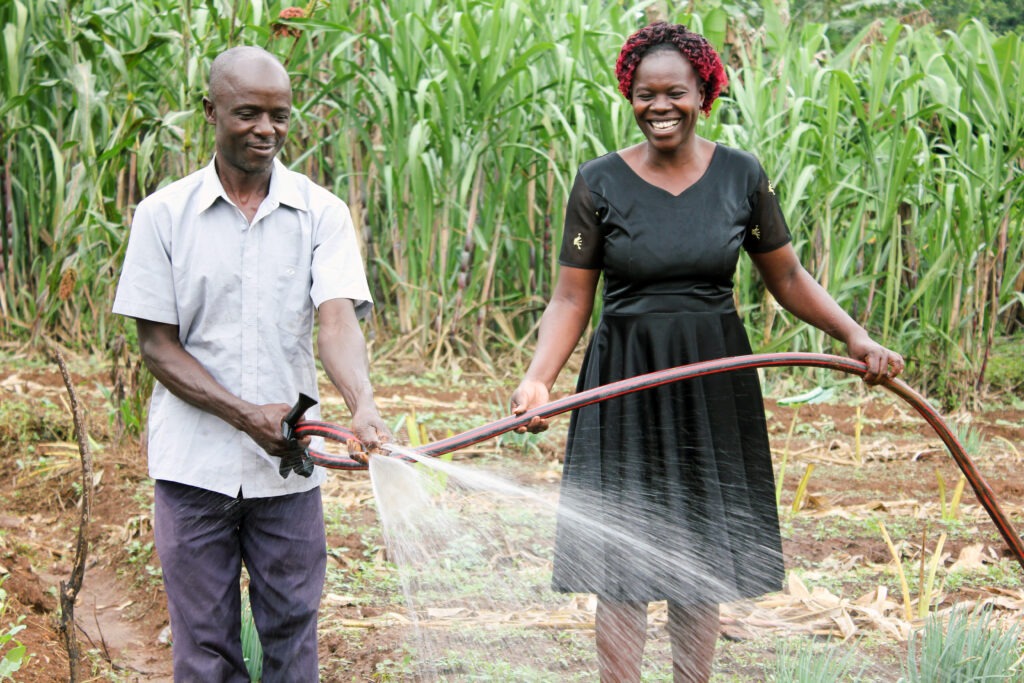
For smallholder farmers, the shift doesn’t have to start with large infrastructure. It can begin with a single pump and practical training.
When a farmer moves from rainfed to irrigated farming, several concrete things change. They can grow crops during the dry season, when vegetables fetch higher prices. They can stagger planting cycles instead of harvesting alongside everyone else in the community, which drives down prices. They can replant quickly after floods damage seedlings, rather than waiting for rain that may not come.
Instead of relying on a single harvest, farmers can produce multiple cycles, and instead of waiting for rainfall to set the schedule, they decide when to plant.
KickStart’s own data backs this up. Farmers using MoneyMaker pumps now grow crops during all 12 months of the year, up from fewer than eight before irrigation. The share experiencing hunger dropped from 42% to just 3% within a year. In FY25 alone, more than 21,000 KickStart pumps reached smallholder farmers, generating $11 million in new annual profits and wages and helping 800,000 people gain access to fresh produce.
The returns ripple outward, too. When a farmer produces year-round, income flows more consistently through the household. School fees get paid, healthcare becomes more accessible, and farm workers earn wages across more months of the year. Local traders can source vegetables outside peak harvest windows, neighbors share pumps, and communities gain steadier access to fresh food.
As one farmer from Kakamega, Kenya, put it: “Most and greatly for us, we’ve been sustained, with our nutrition. Because when we produce, the first produce is for us before we take it even to the market.”
The farmers most exposed to drought are the least protected
Across sub-Saharan Africa, water resources are abundant. Yet less than 5% of its farmland is irrigated, compared to more than 40% in Asia. The vast majority of smallholder farmers still depend almost entirely on rainfall.
That dependence shapes every growing season. When rains arrive late or stop early, yields shrink. When heavy rainfall falls in a short window, fields flood and seedlings wash away. Then the dry months follow with little to sell and income tightening, often right when school fees are due.
The McKinsey analysis puts the scale of this gap in stark terms. About 85% of people in low-income places currently lack protection against major weather hazards, and rural areas are significantly worse off than cities. The farmers most exposed to drought are also the least likely to have access to affordable irrigation, meaning the market alone will not close this gap.
If current protection levels simply hold through projected warming, sub-Saharan Africa will cover only about 15% of what’s actually needed. Even with strong economic growth, that rises to just 25%. The rest has to come from public investment, development finance, and the kind of work that puts affordable, proven tools within reach of farmers who cannot wait for large-scale infrastructure.
The opportunity is real
For smallholder farmers, irrigation means greater stability: the ability to grow food in the dry season, plan beyond a single harvest, and absorb a bad year without losing everything. The McKinsey report confirms that scaling irrigation is one of the strongest investments available for protecting farming families and building rural food security, with returns that few other tools can match.
The irrigation gap across sub-Saharan Africa is large. So is the opportunity. Getting affordable irrigation to the farmers who need it most is exactly where investment in agricultural resilience should go.
—
Frequently asked questions
What is the most cost-effective tool for protecting smallholder farmers from drought? Research shows that irrigation is one of the most effective and highest-return drought protection measures available. With adequate water supply, it protects against 90–100% of expected crop yield loss from drought and delivers a benefit-to-cost ratio of 5–10 times, making it one of the strongest proven investments in agricultural resilience.
How does irrigation help smallholder farmers cope with extreme weather? Irrigation gives farmers control over their water supply regardless of rainfall patterns. This means they can grow crops during dry seasons, replant quickly after floods, stagger harvests to get better prices, and maintain consistent income year-round. KickStart’s data shows that farmers using irrigation grow crops during all 12 months of the year, compared to fewer than eight months before irrigation.
Why don’t more smallholder farmers in Africa have access to irrigation? Less than 5% of farmland in sub-Saharan Africa is irrigated, despite abundant water resources across the region. The gap comes down to access and affordability. Large-scale irrigation infrastructure is expensive and slow to build, and most smallholder farmers cannot afford commercial irrigation systems. Affordable small-scale solutions, practical training, and distribution through local markets are essential to closing this gap.
Want to help scale farmer-led irrigation? Contact us at kickstart@kickstart.org.
Read the full research report: Advancing Adaptation: Mapping Costs from Cooling to Coastal Defenses